
12 Micro Storytelling Examples That Show What Personality-Led Content Looks Like

Most content advice about adding personality to your writing sounds the same: write like you talk, be authentic, and let people see who you really are. That all sounds good, but it does not show you what this actually looks like in practice. It does not help you spot the difference between a LinkedIn post that feels like a press release vs. one that makes someone stop mid-scroll to save it. It also does not give you a clear standard to aim for.
In this article, you will find twelve real examples ofmicro storytelling in marketing, (similar those found in themicro storytelling examples): five for solo service providers, two from well-known brands, and five made for social platforms. Each one is written to the standard you would want for your own content.
If you have been looking atbrand storytelling examples and wondering what the final result should look like, this article will show you. Let the examples prove that one real moment, shaped with the right structure, can be enough to make an impact with your audience.
Contents

The moment you stop explaining and start showing — that is where the story actually begins.
What Makes a Micro Story Actually Work
Before we look at the examples, here are a few things that help a micro-story succeed. These are the three things I check when I write or edit this kind of content, and I hope you’ll keep them in mind as you read.
1. Use specific details instead of general statements. For example, saying "I had a client who was struggling with confidence" is easy to forget. But if you start with "She had rewritten the first line of her LinkedIn bio eleven times in six days," it draws you in. Details show what really happened, compared to a vague story about confidence.
2. Focus on sharing a real moment instead of just stating a fact. It’s more powerful to let readers experience the moment with you than to simply say something changed your perspective. Micro-stories work best when readers find and infere the meaning for themselves. Describe the Tuesday morning or the emotions from the email or the face you made when you read it. Let the insight come from the scene itself.
3. Aim for a real, human voice instead of making everything sound perfect. Writing with personality doesn’t mean you should be careless, but it should feel like one real person talking, with dynamic flow, opinions, and the occasional aside you wouldn’t see in a corporate piece of writing. As you read the examples below, notice how many include a surprising sentence or a moment of honesty that makes the story real.
Micro Storytelling Examples for Solo Service Providers
If you’re a coach, consultant, writer, designer, photographer, virtual assistant, bookkeeper, or any other solo service provider, these examples will be great inspiration for you. Focus less on the exact words and more on the approach and for more on why this works for client-based businesses, see: building trust through stories.
Example 1: The Turning Point (for a life coach)
Maya had the morning routine admired by everyone, ever wanting to live a more productive life— the journal, the affirmations her last coach had prescribed, everything you can imagine. I wondered why she even needed me in the first place.
She showed up to our first session with a colour-coded planner and a list of goals she had written in her best handwriting. She was organised and super determined and also extremely exhausted! And a good night's sleep wasn’t going to fix this.
About twenty minutes in, I asked her what she would do on a Tuesday afternoon if no one was watching and nothing needed to be produced. She went very quiet, almost couldn’t even answer.
Then she said, "I actually don't know."
That was the beginning of the real Maya.
Story type: The Unexpected — the moment that redirects what the reader assumed was coming
Platform: LinkedIn article opener or email newsletter
Why it works: Many readers will see themselves in the colour-coded planner. It shows both competence and hidden “try-hard”. The Tuesday question stands out because it’s specific and mundane. Instead of explaining coaching, the story shows the moment it really starts with a client that may seem to have it all together.
Example 2: The Small Observation (for a brand designer)
Last spring, I was making a mood board for a client, a therapist who always described her practice as 'calm and professional.'
Every image she sent was cool-toned, minimal, and a bit clinical—just what she said she wanted - except one. The profile picture she selected from herself – the one she picked without thinking about branding – was warm.
It had late afternoon light, a plant in the background, and a slightly blurry look, as if someone caught her off guard and it still turned out great. That photo was the real brand.
So we started over.
Story type: The Small Detail — a simple observation that changes the entire overall direction of the work
Platform: Instagram caption or blog introduction
Why it works: The story’s power comes from the difference between what the client said she wanted and what she actually chose. It shows the designer’s attention to detail without saying it outright. The final words, "We started over," are strong because they’re left clear and unexplained.
Example 3: The Mistake (for a business consultant)
In 2019, I gave my client the worst advice I ever gave and with total confidence.
A small food brand wanted to grow, and I told them to focus only on wholesale and stop direct-to-consumer. It seemed logical and financially sound. I even made a whole presentation about it.
They followed my advice but by mid-2020, their wholesale accounts had paused or cancelled, and only their direct-to-consumer channels—the ones we had set aside—were keeping businesses like theirs going.
I think about that presentation a lot. Now, I never suggest a single-channel strategy without asking: what if this disappears tomorrow?
Story type: The Lesson — failure reframed as the origin of a new working principle
Platform: LinkedIn post or email newsletter
Why it works: Naming the year and the industry makes the story feel real. The consultant is clear about the mistake, takes responsibility, and explains what changed. This kind of honesty builds trust fastest.
Example 4: The Ordinary Tuesday (for a virtual assistant)
Last Tuesday, I updated four email sequences, rescheduled three client calls because someone’s childcare fell through, chased two overdue invoices for a client who hates doing it, and wrote a process document so an intern could finally update the website without breaking it.
I know, none of this sounds special.
But by 3pm, my client had finished her tasks, eaten lunch sitting down, and sent me a message saying, 'I feel like I can actually breathe today.'
That’s the result of the job I do —it’s not just the to-do list, but giving clients space to think.
Story type: The Reveal — the ordinary scene that reframes what the work is really for
Platform: Instagram caption or LinkedIn post
Why it works: Listing the Tuesday tasks on purpose makes the client’s message stand out more. "I feel like I can breathe think today" shows a weight being lifted from their client and the gratitude expressed, which makes it powerful. The last two lines shift how you see the service, without selling it.
Example 5: The Boring Story (for a bookkeeper)
I reconcile accounts. I know. I know how that sounds.
For years, I avoided sharing what I really do because I thought no one wanted to hear about numbers and spreadsheets. But then I posted about finding a £3,200 duplicate payment a client had been making for eleven months without noticing, and that post got more responses than anything I’d written in two years.
It turns out people love to hear about finding free money. I have tons of those stories but i’ve just been keeping them to myself for no good reason.
Story type: The Reframe — resistance to self-promotion becoming the story itself
Platform: LinkedIn post or email newsletter
Why it works: This story is about the fear of being boring, which every service provider can relate to if they’ve ever thought their work was too niche or dull to share. The £3,200 detail is the turning point—real and specific. The last line ends with a quiet, knowing smile (knowing they have more stories to share).
Two Brand Storytelling Examples Worth Studying

Two versions of the same truth — the concept at the heart of Dove's Real Beauty Sketches
Most lists of brand storytelling examples use campaign summaries and marketing overviews, giving you only a broad sense of what a brand stands for. This section is different. Here, you’ll find two examples built around real, specific moments: a scene, a person, and a decision.
Dove — Real Beauty Sketches (2013)
She sat down on one side of a curtain. On the other side, a forensic sketch artist named Gil Zamora, who was trained by the FBI, waited. He could not see her. She described her own face: the jaw she thought was too heavy, the freckles she always noticed, the features she found lacking.
Zamora drew what she described.
Later, a stranger who had spent time with her that day described the same woman, and Zamora drew that version too. When the two portraits were placed side by side, the difference was clear. The stranger’s sketch looked like someone you’d want to know. The woman’s own description looked like someone expecting judgment. One woman looked at the two sketches and said quietly, ‘That one looks more like a happy person.’
She was not talking about cheekbones.
Story type: The Contrast — two versions of the same truth held up to each other
Framework: The Truth
Source: Dove Real Beauty Sketches campaign, 2013. Sketch artist Gil Zamora is named in Dove’s own campaign documentation at dove.com.
What makes it work: The curtain is the detail that turns this into a story instead of just a social experiment. The physical separation, with one person describing herself without being seen, creates the scene. The sketch artist is named. The woman reacts. The line about ‘a happy person’ stands out because it was genuine; it came from someone looking at two drawings of herself and speaking honestly.
Solo business equivalent: What do your clients believe about themselves or their work that doesn’t match what you see? The gap between how they describe their abilities and how you experience them — that is the space your service occupies. Your version of this story is the client who downplays their skills in every email, then sends you something that makes you stop and take notice. Identify that gap.
Patagonia — Don’t Buy This Jacket (2011)
Rick Ridgeway had been thinking about the problem for months. It was 2011, and Patagonia, a company built on making products people would buy, was trying to figure out how to tell people to stop buying things.
The Common Threads program was already running: Patagonia would repair your gear, buy it back when you were done, and recycle what couldn’t be resold. But Ridgeway wanted to do more.
He created a full-page newspaper ad. Above a photo of Patagonia’s R2 fleece, he wrote four words: Don’t Buy This Jacket.
Below, the company listed exactly what making that jacket cost the planet: 135 litres of water, 20 pounds of carbon dioxide, and waste equal to two-thirds of the jacket’s weight.
On Black Friday 2011, the ad ran in the New York Times. Sales rose 30 percent the next year.
Story type: The Paradox — doing the opposite of what the situation demands, and meaning it
Framework: The Unexpected
Source: Patagonia’s own account at patagonia.com; origin story reported by David Gelles, November 2025.
What makes it work: The story includes a named person (Ridgeway), a specific date (Black Friday 2011), a specific publication (the New York Times), and a specific product (the R2 fleece). This isn’t just a brand positioning statement. It’s a real decision made by someone that changed what the company stood for. The fact that sales increased isn’t the main point. The real point is that one person wrote four words and truly meant them.
Solo business equivalent: When have you told a potential client something that wasn’t in your commercial interest? Maybe you recommended a cheaper option, referred someone to a competitor, or told someone they weren’t ready for what they wanted to buy. That kind of honesty is your version of the Don’t Buy This Jacket moment. It’s almost always your strongest story.
Micro Storytelling Examples for Social Media
Each social media platform has its own limits, its own pace, and its own reasons for making someone pause so these examples will be more focused. On LinkedIn, you have a bit more room to tell your story. On Instagram, every sentence has to count. With email, the subject line alone has to convince someone to open it. The same principles—being specific, capturing a real moment, and sounding human—show up differently depending on where your story appears.
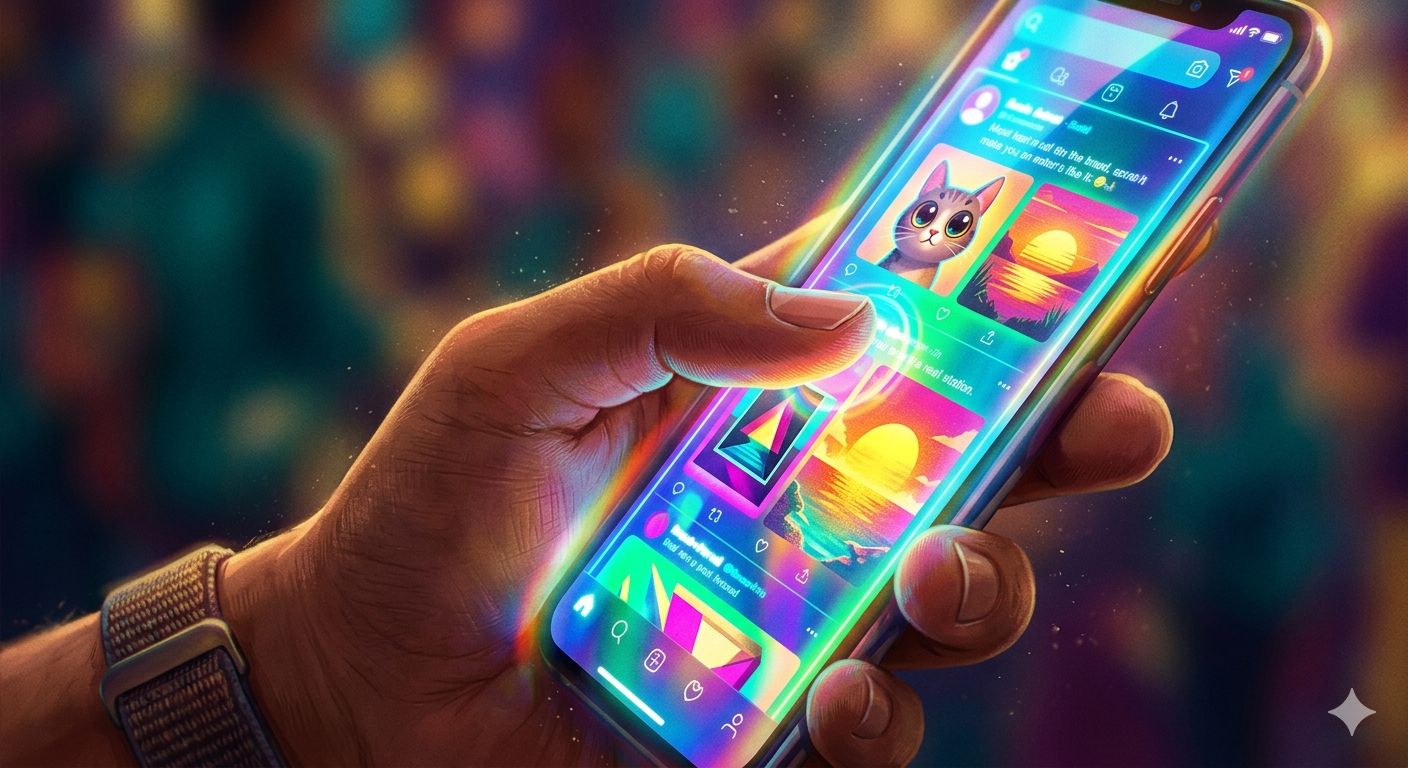
The feed moves fast. A micro-story is what makes someone stop
LinkedIn Post 1
I sent a proposal last year that I was genuinely proud of. It had a clear scope, fair price, and strong case studies. The client came back and said it felt too formal. I was annoyed for about twenty minutes and then I realised she was completely right.
I had written to impress rather than to connect.
I rewrote it in two hours using real sentences and a story about a previous client who had been in a similar position. She signed the same day.
If your proposals are not converting, it might be the voice you’re writing them with.
Why it works on LinkedIn: This post uses a confession-to-lesson structure, which works well on LinkedIn because it gives readers something useful. The last paragraph delivers the main point clearly, without being too forceful.
LinkedIn Post 2
Three things I stopped doing when I started getting better clients:
→ Describing my service in terms of deliverables instead of outcomes
→ Writing 'I work with businesses who...' when I meant 'I work with founders who are exhausted by...'
→ Pretending the process is tidy when the good part is usually the messy middle.
All of these came from conversations that made me uncomfortable.
Why it works on LinkedIn: The arrow format is easy to read quickly but still specific enough to catch attention. The last line changes up the usual self-help list by sharing something honest, which helps build trust.
Instagram Caption 1
I had a client once who told me she had never liked anything she had ever written. Not one thing.
Not a single email or caption or website page.
We worked together for three months and at the end she sent me a message that said: I just read something back and I didn’t cringe at it. That was it.
That was the whole message. I have kept it. (This is what I do. If your content feels like it was written by someone else, let's fix that. Link in bio.)
Why it works on Instagram: The call to action in parentheses at the end is gentle, so it doesn’t feel like a hard sell, but it’s still clear. The story itself shows what the service does—when you read it, you get a sense of the result right away.
Instagram Caption 2
The content that gets the most replies is never the one I spent three hours on but the one I wrote in fifteen minutes because I was thinking about something that happened that morning.
That's not an accident.
That's what happens when you stop performing and start talking and your content can have the same effect. (That's what storytelling-based writing is for.)
Why it works on Instagram: Short paragraphs and line breaks fit Instagram’s style. The writing feels lively but not pushy. The parenthesis at the end gives a gentle call to action, just like the last example, so you can use this approach again.
Email Subject Line + Opening
Subject: I almost didn't send this email
I wrote this three times before I finally sent it.
The first version sounded too put together.
The second tried too hard to be casual.
For the third one, I just wrote as if I was talking to someone I already know, because I am.
If your emails feel like a performance, that’s the real issue. Let me show you how to fix it.
Why it works as an email: The subject line makes you curious without being clickbait. It describes a feeling many people have had before they even open the email. The opening matches the subject right away, which rewards the reader and draws them into the story.
What All Examples Have in Common
These examples come from different voices, industries, and platforms, and vary in length. Still, if you read all, you’ll notice three things they all share.
1. Each one begins with a specific moment, not a broad statement. Instead of saying "I believe in the power of connection," it’s "she had rewritten the first line of her LinkedIn bio eleven times in six days." Being specific isn’t just for style—it gives the story a reason to exist. And without it, readers have no reason to believe any of it really happened.
2. They all sound like one person talking. There’s no committee behind these sentences, and nothing has been smoothed out by an approval process. Even the brand examples use a single narrative voice—one perspective, one set of eyes on one scene. That’s what personality-led content really means: not quirky, forced, or "relatable" in the overused sense. Just a real person, speaking.
3. Each one leaves the reader with something—a feeling, a realization, or a new way to see something familiar. The bookkeeper’s post makes you think about your own untold stories. That lingering thought after you finish reading is the whole point.
If you want to understand the structures behind what makes each of these work, the micro storytelling frameworks that underpinned these examples are all laid out in detail.
How to Write Your Own Micro Stories (Starting Today)
These examples are meant to show you the standard, and it’s completely achievable with one real moment and a bit of structure. Here are three ways you can start right now.
Pick one moment from the past week that surprised you, annoyed you, or made you think. That’s your raw material—not a campaign idea or a content topic, just a moment. Maybe it was a conversation that stayed with you, an email that made you pause, or something you noticed on a Tuesday morning that you couldn’t stop thinking about. If it made you feel something, it’s worth writing about.
Write about it using the Problem → Moment → Transformation structure from these frameworks. Where did it begin, what happened next, and what should the reader take away? It doesn’t have to be long or fully resolved. It just needs to be honest.
Read it over and remove anything that explains instead of showing. If you start a sentence with "This shows that..." or "What I mean is..." or "The lesson here is..."—cut it. Your reader is smart enough to get it. Trust the moment to speak for itself.
FAQ:
-
Micro storytelling in marketing is any time a brand or business uses a short, specific human moment to make a point instead of leading with a claim or a feature. It shows up in email subject lines that reference a real situation, LinkedIn posts that open with a scene rather than a statement, Instagram captions that put you inside a client conversation, and blog introductions that start with the moment before the insight rather than the insight itself. The examples in this article cover all of those formats.
-
A micro story is typically 80–150 words when used as an introduction or standalone piece of content. On social media it can be shorter — even three or four sentences can carry a full story if the specificity is there. What matters is not the length but the completeness: a micro-story should have an entry point, a turning moment, and something that stays with the reader. The best ones take less than a minute to read and stay in your head for considerably longer.
-
A case study makes a case — it presents evidence, results, and outcomes in a structured format designed to convince. A micro-story creates an experience. It is not trying to prove something; it is trying to put you inside a moment so that you arrive at the feeling yourself. Case studies are valuable, but they ask the reader to evaluate. Micro-stories ask the reader to feel. The best content often uses a micro-story to open the door and lets the case study walk through it.
-
Start with the moments that already have a feeling attached to them. The client message you saved because it made you feel something. The day a project went wrong in an instructive way. The question someone asked that made you realise you had been answering a different question for years. Micro-stories are almost never invented — they are excavated. The best ones are usually the ones you have been sitting on because you thought they were too small, too specific, or too ordinary to be useful. Those are exactly the ones.
The Standard Is Achievable
Theory tells you what micro-storytelling is but examples show you what it actually looks like — and more importantly, what it feels like to read. Every piece in this collection started with one real moment, one specific detail, one voice that sounds like a person rather than a brand. That is the standard and it is not out of reach.
If you are a solo service provider who reads content like this and thinks "I want mine to sound like that" — that is entirely possible. It does not require a writing background or a content team. It requires knowing where to look and having a framework to shape what you find. Everything you need to understand the structures behind these examples is in the micro storytelling marketing pillar, and the micro storytelling frameworks article walks through the specific approaches used in the examples above.
And if you want to keep going with this — I write about voice, storytelling, and writing for solo businesses every week. Come find me on Substack →
