

Micro storytelling marketing is the reason a one-sentence Instagram post can make you want to hire someone you've never met.
There’s a woman named Lily, she runs a one-person bookkeeping business. Her content is as you would expect, technical advice, educating people on bookkeeping, highlighting her service etc. But as helpful as it is, no one engages.
Until one day, I noticed she posted a story that started like this: “I always dread tax season…” From a bookkeeping expert, you don’t really expect them to be this honest, admitting that they don’t like the one season that makes their business skyrocket. But yes, she actually said she doesn’t like tax season. So I was curious why she hated it so much and wanted to know more.
And in the story, she went on to talk about the reason she hates tax season and it had nothing to do with the amount of work or the bookkeeping task itself but rather it was filled with crying clients. Clients crying out in relief that she was there to do the thing they dreaded the most.
It turns out, Lily has always felt uncomfortable with tears and crying so that’s the reason she hated tax season but she really loves that she gets to help people by doing what she does, bookkeeping.
In just a few sentences I went from disbelief to curiosity to tension to relief — taken completely on Lily's journey. I felt how real of a person she was and how much her clients must love her that I wanted her to do my bookkeeping too. She didn’t sell anything in that post but I wanted to buy. That’s the power of micro storytelling.
So in this article, we are going to break down what exactly micro storytelling marketing is, why it outperforms long-form brand narratives in almost every modern content format, and how to use it in your own business for your blog post, Instagram post, LinkedIn post, Substack, or website.
Contents
We will cover micro storytelling examples, the frameworks I use with clients, templates you can steal and the biggest takeaway: Why this approach works especially well for solo service providers.
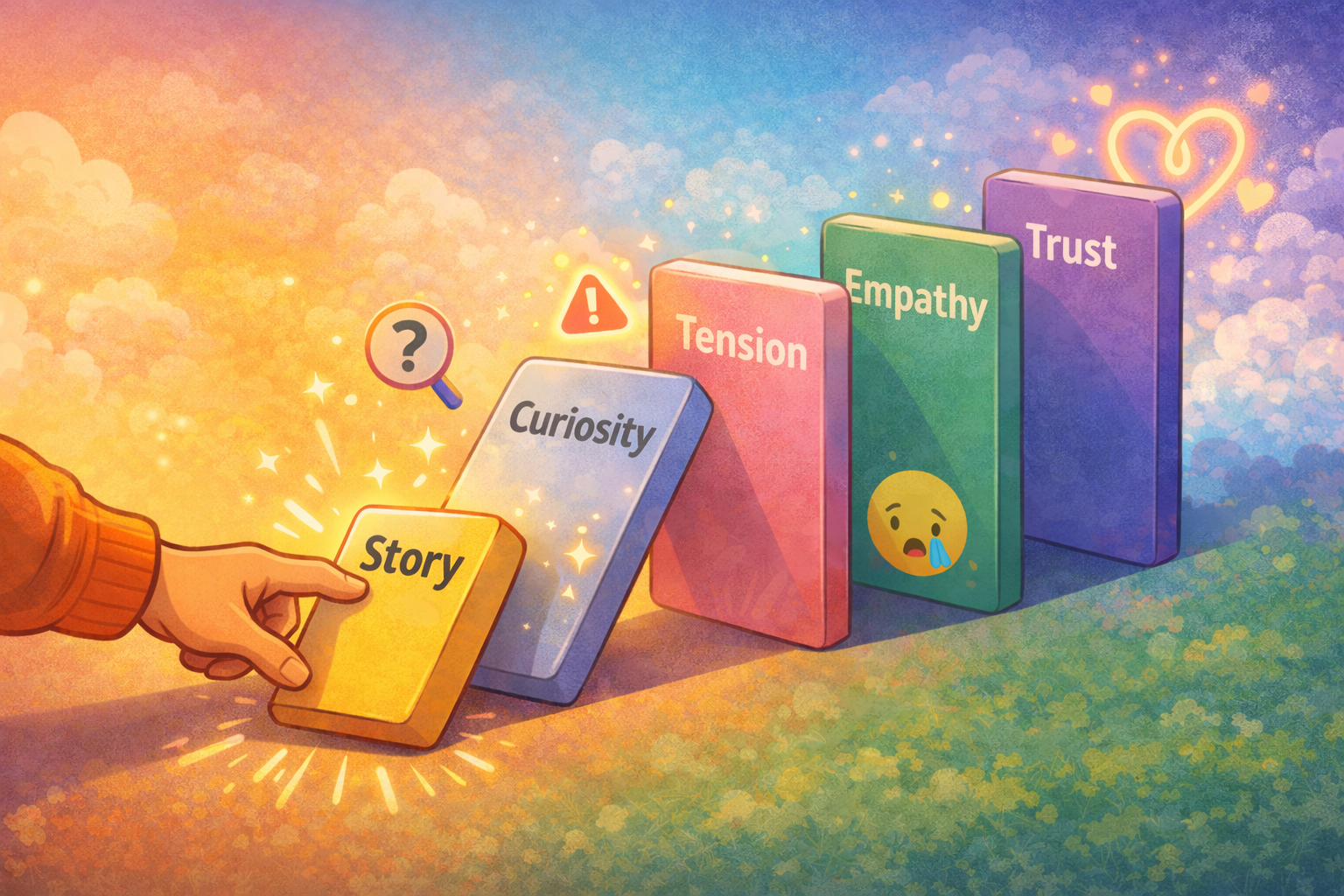
The micro story emotional domino effect
What is Micro Storytelling in Marketing
So what is micro storytelling exactly? It's the practice of using a short narrative — a few sentences, sometimes just one — to create an emotion or journey of emotions that connects your audience to your message. Like traditional stories it has a beginning, middle and end, but condensed. One focus person, one real moment, one feeling.
Micro stories show up everywhere in business content — blog openings like this one, Instagram carousels & captions, LinkedIn posts, about pages, website homepages. Micro storytelling is not a content format but a technique that makes every format work better. It's why I built my entire content approach around it.
Why Micro Stories Work in Marketing?
There are tons of statistics and research quotes on the effectiveness of storytelling marketing but let's skip the cited research and look at the real life tangible impact instead.
They are short and concise. This is where short storytelling marketing has a real advantage — a micro story catches attention precisely because of how small and relatable it is. The brain processes a real human experience faster than any abstract claim and in the age of doom scrolling, that speed is everything.
They are emotion triggers. Humour, relief, empathy, recognition — a well-written micro story triggers these without the reader realising it. Trust is built before they've consciously decided to trust you. The emotional groundwork is already laid by the time you make your ask.
They are engagement machines. People are wired for story. And stories create feelings, and feelings drive reactions — shares, comments, saves, replies. Every platform rewards that compounding engagement by extending your reach to more people.
In short, a micro storytelling strategy performs because it works with human attention — easy to enter, hard to ignore, and built for the way people actually read.
The 3 Types of Micro Stories Every Business Should Tell
Every business owner is sitting on more story material than they realize. These three types cover the majority of high-performing brand content.
1. The Founder Story
The moment of uncomfortable or unconventional realization that led you to where you are today.
Example: Eight years in corporate finance give me the best pay and flashy title…and I burned it all down. Meeting after meeting, I witnessed small businesses get eaten alive by fees, contracts and accounting and finance jargon that they didn't understand and were embarrassed to admit. Expecting the big firms to cater whole heartedly to small businesses is hardly possible and their books suffered because of it. People who were brilliant at their work were being made to feel stupid about their own money. That's a failure of the industry that doesn’t feel right to me. This is why I went solo, to be the person that small businesses I knew never got to have.
2. The Client Transformation Story
Where was your client before they found you, and where are they now?
Example: My client was pulling her hair out over her first tax season as a new solo business owner. Rumaging through receipts, reaching out to freelancers on upwork that never replied, googling and ChatGPT-ing accounting and tax filing she had no clue about until she saw my instagram page. She DM’ed me, I replied and assured her that I can take care of what she needed and clarify what she didn’t understand and after we crossed the storm together she said “Thank you for holding my hand through this.”
3. The Behind-The-Scenes Story
What does your process look like from the inside — the part clients don't see until they're in it?
Example: Before I take on a new client, I make sure to tell them three things: There are no stupid questions here, I can answer every question as many times as they need and this is fun for me so we’re going to have lots of fun working together. Most of them laugh immediately and others pause – seeming like awkward silence – but they let out a long breath, knowing that they can now trust me and my work.
The Micro Storytelling Framework (Step-By-Step)
These are the three storytelling frameworks I return to every time — and they don't fail me.
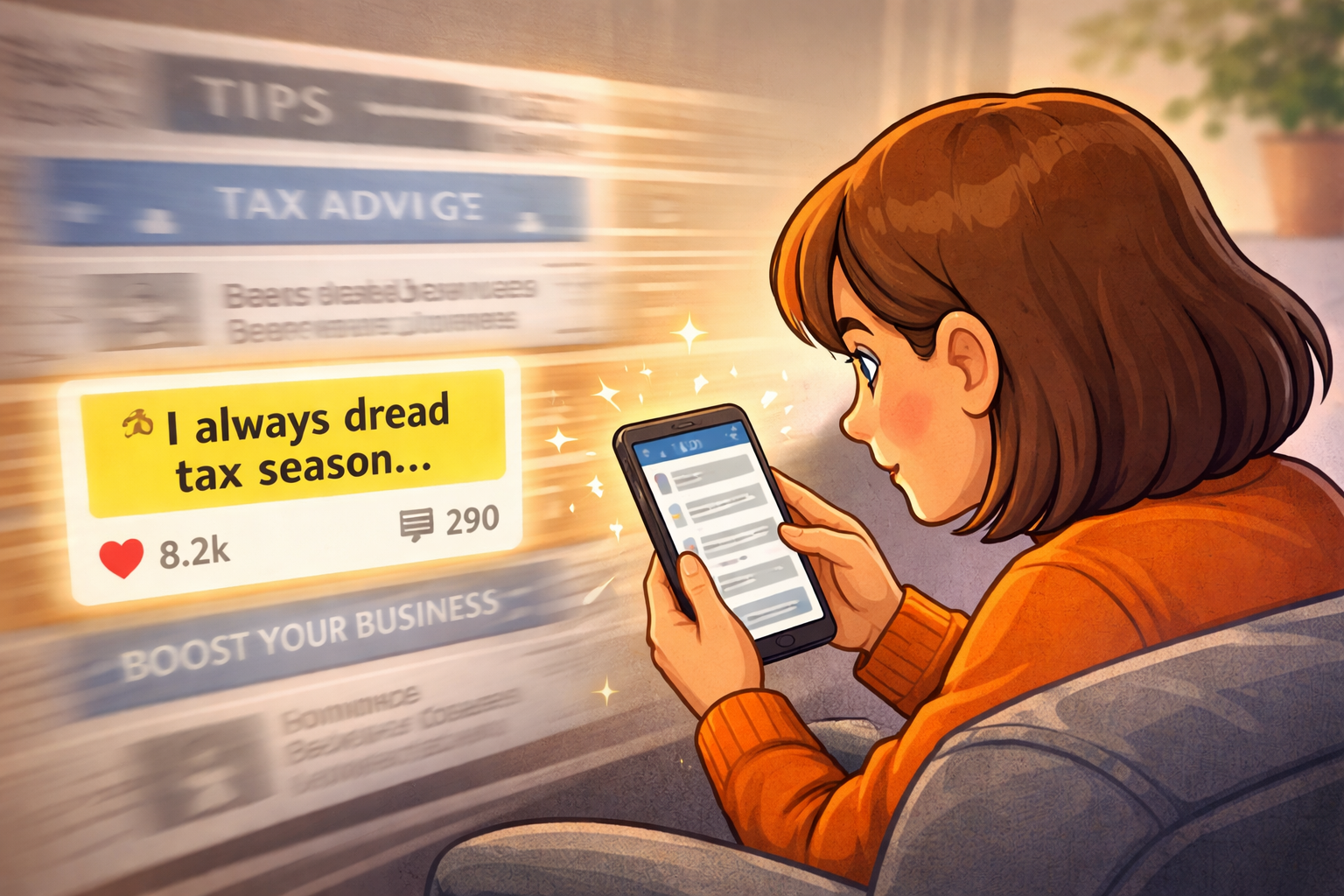
The scroll-stopping effect of micro stories
Framework 1: Before - After - Bridge (BAB Framework)
This is the framework I reach for to show a result – proof that something worked and worked well. It shows the specific contrast between where someone was and where they ended up, with you (the business) as the bridge between the two.
Before: the starting pain or situation → After: the new reality → Bridge: how they got there and who helped them cross over.
Example:
Before: She came to me with a carrier bag she'd been filling for two years — receipts, invoices, an HMRC letter she hadn't opened because she was afraid of what it said.
After: We spent one afternoon going through all of it. When the bag was empty she sat back and said: 'I didn't realise how heavy that was until just now.'
Bridge: She didn't need a new system or expensive software that would confuse her more. What she needed was someone to sit with her and make it feel survivable.
Framework 2: Problem - Solution - Result (PSR Framework)
This is the most used and versatile framework. Almost every piece of educational content, a blog post, carousel, a newsletter, has a problem, a solution and a result somewhere inside it. The skill is finding the real problem underneath the surface. Lily's clients don't have a receipts problem. They have a fear-of-money problem. That's what the PSR has to name.
Problem: what the audience is stuck on or having difficulty with → Solution: the method or change or idea you want to implement or teach → Result: what changes when the solution is applied
Example:
Problem: A lot of business owners are genuinely scared of money. They have anxiety around the statements, payments and bills and it freezes their growth.
Solution: So before we touch a single spreadsheet, I ask them to tell me about their relationship with money - there may be past experiences and wrong beliefs that affect them so we uncover them.
Result: That one conversation changes the whole dynamic. They stop avoiding their inbox, they stop putting off their monthly review, and somewhere along the way the numbers stop feeling like a verdict. One client told me recently: 'I actually looked forward to doing my books this month.' That sentence would have been unthinkable six months earlier.
Framework 3: And - But - Therefore (PSR Framework)
This is the framework I trust most on social media because the 'but' does all the work. Without it you just have a status update. With it you have a story.
And: The current situation your reader recognises → But: the conflict, obstacle or unexpected truth → Therefore: the insight or shift that follows
Example:
And: You run a small business you love and pour your heart into it every single day
But: Late payments and messy receipts keep you on edge about your cash flow and you start to second guess if you have real success.
Therefore: A 15 minutes money story session every week is all you need to turn that fear into confident growth.
5 Micro Storytelling Examples in Marketing
These business storytelling examples come from five different niches. Each one uses a different framework and a different emotional angle, but they all follow the same logic as Lily.
1. Personal Stylist - A.B.T Framework
Julie had a wardrobe full of clothes and nothing to wear. And every morning she’d stand in front of it for twenty minutes, late again, putting on the same three things – a black shirt, blue jeans and a black jacket. The issue wasn't really about the clothes, but really she just didn't know what she was trying to look like anymore. So we didn't go shopping first, we just talked instead.
2. Brand Photographer - P.S.R Framework
Most of my clients come to me with the same problem: they hate how they turn out in photos. The way they imagined they looked does not show in the final product. They feel being in front of the camera isn’t their strong point so they just avoid it. So before I pick up the camera I spend some time just talking to them and by the time we start shooting they've forgotten to be self-conscious. Those are always the best shots.
3. Couples Therapist - B.A.B Framework
They came in sitting at opposite ends of the sofa, it was a natural instinct of two people who had stopped reaching each other, gradually growing distant. Six sessions later she told me something small but memorable: “We’ve started finishing each other’s sentences again.” It was like she had a tiny secret and didn't want to jinx it. They found their way back to each other.
How to Use Micro Storytelling on Social Media
The core story doesn't change across platforms. The structure, length and angle does — because Instagram, LinkedIn and email are three completely different relationships to attention.
Instagram storytelling is fast, visual and emotional. The first line determines everything — whether it's on-screen text in a Reel, a caption, or a carousel slide. Drop directly into the feeling with no introduction or context.
Example (hook): As a seasoned bookkeeper, I hate tax season…
There is no explanation or introduction in the first sentence of the micro story, we drop directly into the feeling.
Storytelling in LinkedIn marketing works differently — there's more patience here than Instagram but less than email. Your reader wants a lesson, not just a feeling. Tell the story in the first few lines then land it with one clear professional takeaway — something worth sharing.
E-mail and Substack
This is the format micro storytelling was made for. The reader has actively chosen to let you in — there's more trust here, more room to be thoughtful rather than just attention-grabbing. Write it like a letter to one person. One to three paragraphs of story, one paragraph of lesson, one clear next step.
Substack doubles as a blog post so make two small adjustments: give it a title that works for newcomers, and end with a question that opens the comments.
There’s a deeper piece on platform-specific micro-storytelling coming - if you want the full breakdown by format.
Micro Storytelling Templates You Can Use Today
Storytelling template marketing works best when the template disappears into the story. These are basic starting points — fill the brackets with something real and nobody will ever see the structure underneath.
Template 1: Founder Story - A.B.T
“I spent [time] doing [previous work or situation]. And [what was good or expected about it]. But [the thing that kept bothering you — specific, honest, one sentence]. Therefore [what you did about it and why].”
Template 2: Client Transformation Story - B.A.B
“[Client description — no name] came to me [where they were, specific detail]. They'd tried [what hadn't worked]. Then [the specific moment or scene where something changed — a quote, a detail, an image]. [What's different now — told as a feeling or a single moment, not a metric]. [The bridge — one sentence on how they got there].”
Template 3: Behind-The-Scenes Story - P.S.R
"Before I [start a project / take on a client / do X], I always [specific habit or ritual most people wouldn't expect]. Not because [the obvious reason]. Because [the real reason — honest, specific]. [What it produces — told as a scene or a client reaction]."
Template 4: Social Media Post - A.B.T
"And [the current situation your reader recognises — familiar, specific]. But [the conflict, the honest admission, the thing that doesn't fit]. Therefore [the insight or shift — said plainly, no question mark]."
Micro Storytelling for Solo Service Providers
The reason micro storytelling marketing works so well for solo service providers — better, often, than the polished content of much larger brands — is that you have something no content team can manufacture: access to real, unfiltered moments. You take every call, you're in every client conversation, you know the details no brief could capture. Large brands construct emotional resonance through creative direction and production budgets. You create it by accurately remembering what a client said last Thursday.
Micro stories for business also work differently at the solo level because trust operates differently at this scale. When someone is hiring you specifically, a micro story communicates that you understand them and that you're the right fit — faster than any service description. We've seen exactly that play out with Lily.
FAQ
-
Micro storytelling in marketing is the practice of using a short narrative — a few sentences, sometimes just one — to create an emotion or a journey of emotions that connects your audience to your message. Like traditional stories it has a beginning, middle and end but it's all condensed. It doesn't need a hero and a villain, just one focus person and one real moment that will leave an impact on the reader. Lily's tax season story was a few paragraphs and it made you want to hire her. That's micro storytelling.
-
The three I come back to every time are Before → After → Bridge for showing results and client transformations, Problem → Solution → Result for educational content that actually teaches something memorable, and And → But → Therefore for short-form social media content that stops the scroll. Each one has a different job. The framework you pick depends on what you're trying to do — prove something, teach something, or earn two more seconds of attention on Instagram.
-
Start with a scenario that happened. A client call, something someone said to you, a moment where something changed your perspective. Write it as plainly as possible, like you would in a conversation. Use at least one specific detail: a quote, a number, an action someone did. You should put the reader in the experience rather than summarising what happened because the story is always in the scene.
-
Brand storytelling is the bigger picture — your origin, your values, your mission and how all of that shows up consistently across everything you put out. Micro storytelling is the technique you use to bring that bigger picture to life in real time, post by post, email by email. Brand storytelling is the architecture. Micro storytelling is what you build trust and emotion with. Lily has a brand story — eight years in corporate finance, left to be the person small businesses never had. But it's the tax season post, the box of receipts, the message that said "thank you for holding my hand" that are the micro stories that made people feel.
Ready to Tell Stories That Make People Want to Buy?
Lily didn't sell anything in that tax season post. She just told the truth about how she felt, it was specific and real — and people wanted to hire her before she'd said a word about her services.
That's the whole argument of this article. You don't need a big dramatic story, all that’s needed is a more specific one. And you already have the material — in your client calls, your process, the things people say to you when the work is done. The skill is in knowing how to shape it.
That's the work I do. At Dahlia Socials, I help solo service providers and one-person businesses write storytelling content with personality — blogs, newsletters, Substacks, and social content. If you want content that creates an emotion and earn your audience’s trust before you've said a word about your services, I’d love to help
Send me a message or an email and let's figure out what your stories could be doing for your business.
And if you want to keep going with this — I write about voice, storytelling, and writing for solo businesses every week. Come find me on Substack →
